Tampilkan postingan dengan label Gigabit. Tampilkan semua postingan

Sabtu, 22 Agustus 2015

TP-LINK TL-SG1008D 10/100/1000Mbps 8-Port Gigabit Desktop Switch, 10Gbps Switching Capacity

TP-LINK TL-SG1008D 10/100/1000Mbps 8-Port Gigabit Desktop Switch, 10Gbps Switching Capacity..


TP-LINK TL-SG1008D 10/100/1000Mbps 8-Port Gigabit Desktop Switch, 10Gbps Switching Capacity

Special Price TP-LINK TL-SG1008D 10/100/1000Mbps 8-Port Gigabit Desktop Switch, 10Gbps Switching Capacity By TP-Link

Most helpful customer reviews

111 of 119 people found the following review helpful.
5Fantastic little switch.
By J. Bair
I wanted to hard-wire the network for my home theater setup. Most notably, an Xbox 360 (100Mbit), a PS3 (1000Mbit), an AppleTV 3rd gen (100Mbit), and the television itself (LN52B630, unsure about speed). Previous, I had the Xbox plugged in directly to my Airport Extreme over CAT5e, and used the wireless on the PS3/AppleTV. However, I wanted to hard-wire the AppleTV for airplay mirroring to speed things up a bit. And if I was going to split the one gigabit connection into more than one, I figure I might as well wire up everything, and a 5 port gigabit switch was exactly what I needed.

Looking around Amazon, this guy had really top notch reviews. Online research showed NewEgg reviewers giving this little guy glowing reviews, with a few nags here and there. There are a few neat hacks people have done to make this switch even more useful, but I won't get into those. I figured for $20, this little guy should do the trick. Plus, Amazon has a great return policy for faulty products, so why not give it a try. I've been burned by high quality names dying out on me for no good reason, so I figured I'd give this little guy a go.

So far, fantastic! I wasn't able to do a very good test to max out the line speed, but the speed did not change between no switch and the switch over the same wire. I checked all ports and they all worked at 1000BaseT just fine, and latency was consistent across all ports. Also, I confirmed that mixed modes caused no issues, as noted by my above devices. Of the 5 ports, 2 are gigabit (uplink to the Airport Extreme and the PS3), and the AppleTV/Xbox are 100Mbit - the TV is most likely 10BaseT, but it may be 100BaseT. Everything is working together flawlessly, though since it's for a home theater setup, it's not being taxed heavily.

If it dies on me or if things end up not working out, I will be sure to come back and update this review. But I figured I'd toss my two cents for other people running into my situation.

63 of 69 people found the following review helpful.
5It stays cool and that means I save money!
By Bubba Guppy
I needed another switch and I bought this one because it was inexpensive, was supposed to be energy-saving, and was well-reviewed across the net.
It works very well, and it runs cool - barely warm to the touch.
Compare that with my Cisco 5-port gigabit switch which is always HOT to the touch.
Heat is wasted electricity and ultimately challenges component reliability.
I would recommend this product to anyone.

26 of 29 people found the following review helpful.
5The Power Consumption Challenge!
By William Hefner
When it comes to unmanaged home gigabit ethernet switches, there isn't really much these days that would set one brand apart from another. Gigabit switches pretty much just sit there and do what they are supposed to do without notice, if they are built right. The specs for gigabit switching haven't changed at all over the years, so manufacturers have had to find other ways to set themselves apart. The battlefront these days seems to be who can build switches the smallest, the cheapest or use the least amount of power. TP-Link seems to have settled on the latter, with the release of it's 8 port TL-SG108 gigabit ethernet switch.

So, the question is... Did TP-LINK actually build a switch that uses less power than other models? Yes, they did. Although the tests I conducted were not under sterile, laboratory conditions, they are certainly accurate enough to show that the TP-Link switch uses significantly less power than switches sold just 2-3 years ago. Running idle (no connections or traffic) the TL-SG108 barely draws any current at all. Perhaps 1 Watt, at most, which is most likely consumed by the LEDs it displays to indicate that it is operational. This is a tad better than switches made a generation ago, but consistent with most other desktop switches made these days.

Under a full network load, the most power that I saw the switch consume was about 4 Watts. I used a consumer Kill-A-Watt brand power meter for testing purposes and set out to test some other 8 port desktop gigabit ethernet switches that I had at my office. Using the same ethernet connections on the same network (representing a similar network load) a handful of the newest switches I tested consumed roughly equal amounts of power. Specifically, I tested models including the TrendNet TEG-S8g, TrendNet TEG-S80g and Zyxel GS108B. All of these models have similar form factors and features and are from the latest generation of each company's products. All seemed to fluctuate between 2 to 4 Watts of power, depending upon the network load at that particular moment. In this sense, the TP-Link TL-SG108 doesn't really stand out above the rest, but it definitely hangs in there with the best of them. The other models I tested also boasted consuming "less power". I suspect that most current models sold these days would be similar in power consumption though.

Compared to previous generations of gigabit ethernet switches, the TP-Link TL-SG108 fared much better. In particular, I put a switch that is still active on our network to the test and the results were impressive. In particular, I tested a 3COM 8 port OfficeConnect model 1670800a gigabit ethernet switch and found that it consumed anywhere from 4-8 Watts under the same load. That's close to twice the power consumed by the TP-Link. Similarly, a Netgear GS605 5 port gigabit ethernet switch (definitely not one of their newer models) had a pretty constant load of about 7 Watts under the same conditions. With fewer ports and close to same size, I expected the Netgear to do a bit better, but the meter doesn't lie. I suspect that the Netgear switch is probably about 5 years old. I didn't have any other, older gigabit ethernet switches left to test, but I suspect that the results would have been roughly similar.

What it all boils down to seems to be that if you are using an older, gigabit ethernet switch you could save 50% (maybe more, maybe less) on your electricity costs by switching to a TP-LINK TL-SG108 or a similar model based upon recent advancements in technology. In real-world terms, we are talking about 5 Watts max. Over the course of a year, this would amount to (at most) about $1 in savings as of this writing. Obviously, if you have an older gigabit switch in place, running out and buying a new one isn't going to pay for itself anytime soon and will just consume more landfill space, if you care about that sort of thing. If you need to buy a new gigabit switch anyway though, the TP-Link TL-SG108 is definitely one of the lowest power-consuming models you will find on the market these days. It compares very favorably to similar models that sell for higher prices. It seems very solidly built and considering the fact that it contains no moving parts, one should expect it to last longer than the amount of time it will take to make gigabit switching technology obsolete.

See all 897 customer reviews...More...


Kamis, 09 Juli 2015

TP-LINK TL-PA511 KIT AV500 Powerline Gigabit Adapter Starter Kit, up to 500Mbps

TP-LINK TL-PA511 KIT AV500 Powerline Gigabit Adapter Starter Kit, up to 500Mbps..


TP-LINK TL-PA511 KIT AV500 Powerline Gigabit Adapter Starter Kit, up to 500Mbps

Special Price TP-LINK TL-PA511 KIT AV500 Powerline Gigabit Adapter Starter Kit, up to 500Mbps By TP-LINK

Most helpful customer reviews

130 of 133 people found the following review helpful.
5Truly Plug & Play and Work Great
By IGold
This item is as described. In reading some of the other reviews, I believe the confusion is in the initial paring of the units. All I did was plug them into two different outlets in the same room (clearly they were on the same circuit) and paired them, I did not even bother to plug in any Ethernet cables. I then moved one unit near my router and the other unit to a distant bedroom, hooked up the Ethernet cables and everything worked as described. I did not use the software resource disk that came with them.

I am getting much faster speeds in the bedroom than I was with Wireless N. I changed the cables to Cat 5e and both units are humming along with green lights. I would highly recommend these to anyone with wireless issues.

Also, although they are bigger than your typical power wart, they are designed so that if you plug them into the bottom outlet of the receptacle, they do not interfere at all with top outlet, leaving it free for a power strip or UPS. This was one of the unknown concerns I had prior to purchase.

For clarification the model I am reviewing is the TL-PA511 KIT.

156 of 165 people found the following review helpful.
4OMG I have internets.
By C. miller
We live in a 100 year old house with plaster walls underneath wood paneling. Pity us. Wireless will not penetrate the walls no matter how many repeaters / antennae / amps / cats with tinfoil you place. My 14 year old daughter was throwing a stereotypical teenage girl conniption fit that her wireless kept dropping out, had a 1mbps downstream, and was generally poo. After some last ditch settings adjustments I ordered these, on the advice from a popular hardware forum.
While they were a little fiddly to initially pair, once I got them installed, it was magic. Digital unicorns flew out of my daughter's Tumblr feed at the speed of 30mbps, and she no longer things I'm a moron.

In other words, works awesome.

86 of 91 people found the following review helpful.
5Just As Good As The More Expensive Brands With Intercompatibility!!
By Hyoun Kim
I've been a Network Engineer for over 10 years and ever since I've dealt with computers, cabling is one of the worst aspects of the job. I can't tell you how many times I've run/extended CAT3/CAT5/CAT5e/CAT6 cabling and ended up terminating both ends and testing them. Some situations are easier than others when you're allowed to run a cable across the floor or above ceiling tile... but in other situations like getting networking in a certain room in your house can be a total pain in the butt.

For the average home user, the only way to get networking from point A to your house to point B is either wired with cabling or use WiFi & bridging if the WiFi didn't extend far enough. When Powerline technology came out it added convenience of using existing power cabling but still was a little flaky and troublesome. But since then, Powerline has jumped leaps and bounds since and is much more reliable & faster.

When it came time to buy originally back in July 2012, I put a lot of research into looking into the latest powerline solution for my home. I wanted something with high performance and the current version of "high performance Powerline devices" allows 500Mbps transfer rate. Even still, I was having trouble selecting which manufacturer to go with (Belkin, Cisco, Netgear, etc). After my homework (and despite Netgear's horrible sales support), I ended up with the NETGEAR Powerline 500Mbps Nano Adapter - Starter Kit (XAVB5101).

Despite the insane price point (currently $87.99 on Amazon - 12/13/2013; I bought these for $108 back in July 2012), the Netgear adapters worked wonderfully in my home. I was able to maintain faster throughput from device to device while on wired Ethernet while not saturating my WiFi network. However, over the course of a year and a half, the number of devices I had in my house grew considerably (especially over WiFi).

In the past year, I added a few cell phones, a laptop, a tablet, a Roku 3, a Western Digital TV Live, 2 Chromecasts, and a new Smart TV. Because of that, my WiFi started to become degraded because every single one of those new devices was connecting to my network over WiFi. When multiple devices would start streaming things like Netflix and I was doing transfers from my media server to a PC, Netflix would stutter and my WiFi throughput would literally crawl slower than a snail on a salt bed. That's when I realized I needed to invest in more Powerline Adapters for certain rooms to speed up transfers as well as help reduce the load of my WiFi network.

But you see, despite being pleased with my Netgear adapters, I didn't want to spend another $100. A friend of mine (who I told the Netgear adapters about) bought another brand of Powerline AV 500Mbit adapters from a company called TP-Link to save money. He said they worked pretty good. After finding out that they were $35 on Amazon, I immediately pulled the trigger. I mean after all, I had a word of mouth approval from a friend and you can't argue saving over $50 vs another set of my Netgear adapters... the result? Absolutely no difference in speeds.

Just like the Netgear adapters, these are essentially Plug & Play. There were literally no problems connecting these in my house. I went to the living room where I needed wired connectivity and plugged these up to the wall. The TP-Link adapter immediately recognized my existing Netgear Powerline adapters and the 2nd LED (Powerline LED indicator) immediately lit up. I plugged in my small 10/100 switch to it and then my Roku & TV up to it and the 3rd LED (Ethernet indicator) lit up and the devices could not only talk to other devices on my LAN, but they had Internet access as well. I personally noticed NO DIFFERENCE in throughput speeds both within the LAN and the Internet.

The *ONLY* difference between the TP-Link set and the Netgear is the that the TP-Link doesn't tell you the "current speed" of that adapter's Powerline network. The Netgear has multicolored LEDs that indicate the speed of your Powerline network. While this normally won't matter to a lot of people, it will tell you whether you are having degraded performance within your home's electrical wiring. It also aids in troubleshooting as well. But it's not a show stopper...

Personally, I would recommend this product over the Netgear adapters I have.
1. The price is a LOT cheaper.
2. TP-Link has a TWO YEAR WARRANTY vs the Netgear's ONE YEAR WARRANTY. If you're really concerned on whether you're buying "a crap product", rest assured that this works just as good as the bigger name brands and you have an extra year of product care!

Highly recommended.

See all 940 customer reviews...More...


Kamis, 09 April 2015

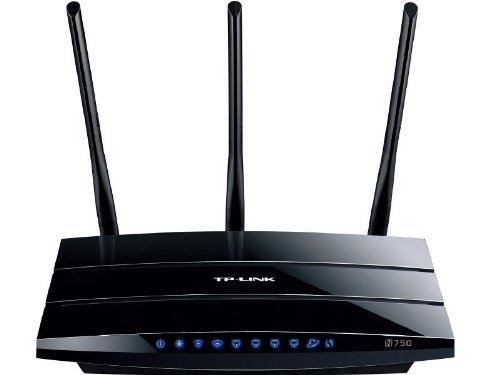
TP-LINK TL-WDR4300 Wireless N750 Dual Band Router, Gigabit, 2.4GHz 300Mbps+5Ghz 450Mbps, 2 USB port, Wireless On/Off Switch

TP-LINK TL-WDR4300 Wireless N750 Dual Band Router, Gigabit, 2.4GHz 300Mbps+5Ghz 450Mbps, 2 USB port, Wireless On/Off Switch..

TP-LINK TL-WDR4300 Wireless N750 Dual Band Router, Gigabit, 2.4GHz 300Mbps+5Ghz 450Mbps, 2 USB port, Wireless On/Off Switch

Grab Now TP-LINK TL-WDR4300 Wireless N750 Dual Band Router, Gigabit, 2.4GHz 300Mbps+5Ghz 450Mbps, 2 USB port, Wireless On/Off Switch By TP-LINK

Most helpful customer reviews

267 of 305 people found the following review helpful.
5Super-fast, great range, lots of features
By S. Lionel
Pros:
+ Fastest dual-band router I have used by far
+ Lots of configuration options in admin panel
+ DLNA server, FTP server, USB printer server and USB storage server
Cons:
- Physically large
- Admin user interface can be confusing

For the last two-plus years I have been using the Netgear WNDR3700V1 dual-band router. At the time I bought it, it was considered one of the fastest dual-band routers available, and it had lots of features. It does work very well, but Netgear has revised it twice and the subsequent V2 and V3 releases have diminished functionality and performance. While I have used many brands of routers in the past, TP-Link was new to me so I was curious to see how the TL-WDR4300 compared.

The router itself is a large box. It's attractive and has a nice design, but it is much wider than competing routers. It is also very lightweight. Perhaps the width is so that the three dual-band antennae can be physically separated more - I don't know. There are keyhole slots on the bottom in case you want to wall-mount it, but as with most all routers, the wiring all goes to the back where the antennae are, so this might be awkward if your wiring comes from below.

TP-Link provides a setup "wizard" on a mini-CD (you can also download it from their web site), but I just connected to it directly and configured it through the admin panel. I was delighted to see that the wireless networks came up pre-configured with WPA security and an 8-digit password - many routers are simply "open" when first configured. This encourages users to maintain security. You can set the wireless to WEP or even open if you want, but that's generally ill-advised.

Unlike a certain other brand of router I have tried two examples of (cough - D-Link - cough), the TP-Link had no trouble negotiating with the Ethernet feed of my FiOS optical network box (the equivalent of a cable modem). Some of the configuration features it had that I liked were:

- Dynamic DNS support (though the selection of providers was limited)
- Separate and easy to understand configuration of 2.4 and 5GHz bands
- Ability to reserve IP addresses to specific devices

Some of the things I didn't like:
- Only a single display of DHCP clients connected, rather than separating wired from wireless
- IP reservation page did not let you select from known connections - you have to type the MAC address
- No "guest mode" - this is a feature the Netgear WNDR3700 has that adds a second network which can be configured to give Internet access only and not access to your local network. This is great for houseguests and the like [Edit - TP-Link added Guest Mode in a later firmware update]

The admin user interface is straightforward, though it uses submenus and some of the pages seemed to duplicate others. For example, there were two different pages where one could enter DNS server addresses, and changes to one did not carry over to the other. While each page had pretty good instructions right in the dialog, some of the options were a bit confusing as to how to set them. But what really got me were the pages where I did not notice at first that a frame of the dialog had a scrollbar, and I had to scroll to the right to see additional links, even though there was lots of space for them to show otherwise. A full manual is on the CD as well as on the web site.

Once set up I tested performance at a distance of about 25 feet through two walls. First I ran tests using the Netgear and then the TP-Link with the same remote server. The TP-Link delivered speeds 30-50% better than the Netgear on both the 2.4GHz and 5GHz bands. The Netgear is very good about coverage in my house - it has eight (I think) internal patch antennae where the TP-Link has three, rather tall stick antennae. I found coverage to be at least as good as the Netgear, even about 50-60 feet away and through multiple walls. I could only go by "bars" of signal strength but it seemed to me that the TP-Link's signal was stronger on both bands. Many dual-band routers are particularly weak on the 5GHz band.

As the three antennae suggest, this router supports the "3X" mode of some Wireless N adapters for a theoretical maximum bandwidth of 450Mbps on the 5GHz band and 300Mbps on the 2.4GHz band. Add those together and you get the "750" emblazoned on the router. The spec sheet I got indicates tested speeds of 241Mbps and 135Mbps respectively, still not shabby. The Ethernet ports are all Gigabit, and the test indicates LAN-WAN speeds as much as 935Mbps. That's fast.

The TL-WDR4300 has two USB 2.0 ports on back. These can connect to USB storage or to a USB printer. For storage the router will make the storage available as a network share, or you can enable an FTP server that can, if you wish, be accessed from the Internet. (The default is off.) Unfortunately, only standard FTP is supported, not SFTP over SSH, so your login information (you can set a username/password pair) is sent unencrypted. My advice is to NOT use this feature over the Internet.

I did not test the print server, as my printer is already network-enabled. For Windows there is a utility you install that, if I understand correctly, pretends to be a USB port and relays information to and from your USB printer. Scanners are also supported.

I did test the DLNA media server. You can specify up to six folders on the USB storage to serve and it will relay audio, video and photos to DLNA clients on your local network. I fired up Goodplayer on my iPad and played a movie from a USB hard disk - it worked beautifully. The promotional material claims that it can serve media over the Internet, but I think this is incorrect - there's no setting to enable/disable it and no instructions for how you would access the media from outside your local network. I will verify this with TP-Link support and update this review when I learn more. (Edit: TP-Link confirmed that media serving is local network only.)

TP-Link's documentation takes the unusual step of saying that one can install and run the freeware DD-WRT router software on some of its routers. I checked at the DD-WRT web site and while the WDR4300 is not yet officially supported, there is a beta version that at least partially works, and development for the WDR4300 is proceeding. According to the spec sheet TP-Link included, the WDR4300 has an Atheros chipset that runs at 560MHz, 128MB of RAM and 8MB of flash - these are rather high values for routers in this price range and suggests great performance and resistance to locking up after being on a long time (a problem I have seen with other routers.)

Lastly, as I do for most products I test, I looked at power consumption. For a device you'll leave on all the time, this can matter. I was pleased to see that the WDR4300 maxed out at 4 watts with wireless on, where the older Netgear router was averaging 6-7 watts. Excellent.

Not only does the TP-Link router seem well-designed, but their web site is easy to navigate as well, unlike those of some more well-known brands.

[Edited February 6, 2014 to note that Guest Mode was added after my initial review.]

101 of 116 people found the following review helpful.
4Lots to Like (vs. an old WRT54G)
By C. MacPhail
.
A few points that may not be covered in the other reviews...

- - - Good documentation - - -

The 125-page PDF User Guide seems well written and helpful. The setup wizard tries to be very clear and helpful, (but was not quite helpful enough for me -- see Note 1). The administrative interface is good at explaining many of the options instead of just labeling them. (Example in Note 3). If your router-IQ is low-to-medium, this is worth a lot.

- - - Bad documentation - - -

The setup wizard **does not urge or remind you to change the admin password**. It ends with "Congratulations...Enjoy surfing the Internet." (see Note 2)

Also, TP-Link provides no clarity on where their router stands with WPS. That's the convenient but very hackable device pairing procedure that some experts say should be disabled. (see Wikipedia: "Wi-Fi Protected Setup")

- - - Good Support - - -

Mac computers don't self-discover a USB file share on the router. I emailed TP-Link and got an answer 6 hours later. (Finder...Go...Connect to Server...smb:192.168.0.1/volume name)

- - - 2.4 GHz vs 5 GHz - - -

Apparently 5 GHz is ideal for apartments (where interference is the main problem) and 2.4 GHz is better in larger homes (where range is the main problem). You can set it to use either band, or both. (See Note 3)

- - - Energy savings - - -

It runs much cooler than my old Linksys WRT54G. Uses 3.95 watts vs 5.85 watts. Sounds trivial, but over 5 years it will save me $27 -- 40% of the router's cost. (see Note 4)

- - - USB ports - - -

A lot of routers have them now. This one supports printer sharing, and file sharing on USB sticks or USB hard drives. Local sharing is file storage and/or media server. Internet file serving is provided by FTP (File Transfer Protocol). Models like ASUS RT-N16 have direct Bit Torrent support in addition. Nice to have stuff available 24x7, even when various PCs are shut off.

- - - Improved Range - - -

I used the free and very cool NetSpot software (Mac only) to map WiFi signal strength throughout my house... TP-Link TL-WDR3600 (2.4 GHz band) versus Linksys WRT54G. The TP-Link lit up some difficult rooms that were marginal with the Linksys. A very measurable difference. Turns out we don't need two routers, just on decent one.

- - - Summary - - -

Router-world gets cheaper and better every year. I don't know if this one is the very best choice, but there are a lot of reasons to upgrade an old router.

- - - Notes - - -

Note 1: I kept failing the wizard's "Verify Router Settings" check. I had taken a little shortcut that seemed harmless, but wasn't. Instead of wiring my desktop PC directly to the router, I connected through my LAN, which had other devices also powered on. The presence of these other devices during setup apparently threw something off. If your desktop computer is 30 or 90 feet away from your cable modem, you could fall into the same trap.

Note 2: It says "The Easy Setup Assistant has completed a basic configuration of the router. For more advanced settings, please log in to the Web management interface." But that interface has 30+ screens. The average user should be told and guided to set a new admin password.

Note 3: Here's an example of the helpful stuff in the router management interface...

Advantages of 5GHz:

The 5GHz band is less likely to be congested. The 2.4GHz frequency range is much more prone to interference, as it is commonly used by other wireless networks in the area, as well as cordless phones, garage door openers and other home appliances and consumer products.

Disadvantages of 5GHz:

In general, the higher the frequency of a wireless signal, the shorter its range. Thus, 2.4GHz networks cover a substantially larger range than 5GHz wireless networks. In particular, the higher frequency wireless signals of 5GHz networks do not penetrate solid objects nearly as well as 2.4GHz signals, limiting their reach inside homes.

Note 4: That arithmetic is for parts of California, where marginal cost is $ 0.33 per kilowatt hour. If your cost is $ 0.11, your savings would be about $9 over 5 years. (1.9 watts * 8760 hours * 5 years * $ .00011 per watt hour.) 3.95 watts is when running 2.4 GHz band only. With both 2.4 and 5 GHz bands running it's 4.35 watts.

~~~ Comments & questions welcome ~~~

73 of 85 people found the following review helpful.
4Good performance, but worrisome pattern of firmware updates and nervousness about security
By Douglas B. Moran
I am currently happily using this WiFi router, but my concerns about its security caused me leave my previous router between it and the Internet.

PRELIMINARIES:
0. Recognize that Amazon has mixed together reviews for a range of different models in this product family -- models that have very different performance, design, features, ... So check that the review is for the model you are considering.

1. Recognize that many of the earlier reviews here contain obsolete information -- problems that have been addressed by firmware upgrades. The 2013-March-19 upgrade added Guest Networking and fixed some other problems. The previous upgrade of 2012-Dec-25 fixed many bugs and performance problems. Having seen the earlier reviews and being a curious techie, I tried the original firmware found that that the _sample_ of reported problems that I could easily test were indeed fixed by the 2012-12-25 firmware.
If you get this device, do NOT disregard these updates thinking that they are only optional (that is, only for those having identifiable problems).

2. (update) Don't stop at the firmware upgrade of 2013-March-19--it has a major vulnerability that is being actively exploited (eg, Web search for CSRF and "router hijack"). There is a subsequent firmware upgrade (2013-06-17) whose description makes it seem innocuous and unnecessary for most users, that update seems to block the version of this exploit that I have access to.

3. The pattern of firmware updates is worrisome. Some of the problems fixed are to be expected: performance problems/enhancements and compatibility problems with certain other network devices. For these, I applaud the manufacturer for putting out fixes on a 3-4 month time scale. HOWEVER some of the other problems are things they should have been correct in the initial release, and consequently I worry about undetected/unfixed problems that remain, especially those related to security since that is a critical function of this device (more below).

In this review, _Security_ comes at the very end for compositional reasons, not because it is low priority.

----
My Background: I evaluate home WiFi Routers on three basic criteria: Security, Performance, and Features, and in that order. I place "Features" last because most home users, and me currently, will not need or use most of the more advanced features. I worked in computer/network security in the 1990s and early 2000s and computer networking starting in the 1980s. Being retired, I now have too small a set of devices to evaluate this router for more sophisticated or demanding settings.

Because friends and neighbors ask for help in setting up/fixing their network problems, I am also exposed to the perspective and choices of the typical home user. This review contains elements of interest to different groups: experts, mass-market consumers,... I have tried to structure the review to simplify your quickly ID'ing and skipping elements that are irrelevant to your interest/experience (not needed, too complicated, too trivial, ...).

----
Features: Summary: The features are as expected for this class of device.

This is unsurprising because this is largely dictated by the chipsets used, and there is relatively modest variability across the competing chipsets at any given time. Because the landscape is ever changing -- what the newest chipsets provide and what device is using which generation of chipset -- my advice is that you use web search to try to find the chipsets used by the various models of router you are considering and if successful look at the reviews of those chipsets as a precursor for comparing the overall router.

The software used in many brands of routers also comes from common software code bases (via different paths) but many manufacturers try to obscure this. And there are various combinations of components, versions-used and customizations-make. While the manual available for download is only minimally out-of-sync with the firmware, the documentation of some of the features is underspecified and can be resolved only through experimentation. But this is quite common for this class of device (not just this model or brand).

The USB printer port worked for my printers -- a Canon MFP and 2 different models of Samsungs. This was only a brief test because the primary printer and the MFP also have Ethernet interfaces (preferred). The utility program was easy to use and worked well.

The USB storage sharing feature also worked, although I don't expect to be using it -- no current need and concerns about the security of the implementation.

----
WiFi Performance: Good
Background: This is replacing a six year-old Buffalo Airstation WHR-G54S with its omnidirectional 2.2dBm antenna replaced by a Hawking Directional 15dB Corner Antenna (Model HAI15SC). I live in an old house that was extended and remodeled several times by previous owners. There are enough perplexing weak/dead spots in my house that I cannot project performance to more conventionally constructed houses.

I tested locations in and just outside my house using the (free) inSSIDer software tool with both routers within 3 feet of each other. In the 2.4 GHz band, the signal strength was equal or slightly better than that of the (enhanced) previous one. Of course, the difference between G and N protocols and 40MHz wide channels improved throughput considerably. For the 5 GHz band, I had no comparables.

I got about 8 Mbps speeds when connecting from across the street -- about 140 ft with some intervening tree foliage. The router is in a front room, but not near a window and my computer was just inside the neighbor's front window.

In the month of use, I have had no problems with the WiFi. No freezing. No unusual patterns of delays or larger latencies. My primary computer is in a separate room, through an open door but well out of line-of-sight, about 30 feet straight line distance.

----
WiFi antenna geometry and separation:
This device has detachable antennas, allowing those that understand optimization of antenna geometry to do so.

Additional spec: Antenna separation: 85 mm (left to center), 98 mm (center to right), 183 mm (left to right).
FYI: For the 2.4Ghz band, the wavelength is roughly 120-125mm; for the 5.0Ghz band, it is roughly 51-58mm.

Background: For a multiple antenna system (such as this), the geometry and separation of the antennas can have significant effect, but I don't know what scheme(s) this device uses and I am too out-of-date to judge whether this device has antennas that are positioned for performance or for manufacturing convenience. Example, one long-established multi-antenna scheme, "Diversity", benefits from having its two antennas separated by one wavelength.

----
Temperature: This device stays cool -- very close to ambient temperature. I have it in a fairly typical location: an out-of-the-way location on a table top that gets somewhat below-average air circulation. Explanation: Heat is a concern because it shortens the lifespan of electronics.

----
Auto-selection of WiFi channel and channel width: This is relevant primarily to a WiFi router that might have another such device placed close to it, such as in neighboring apartments or companies or departments in a suite of offices. Or not, depending on the nature of the walls in between. I live in a dense suburban setting, with my immediate neighbors' WiFi routers about 50 feet from mine, and we have yet to see any signs of interference (unsurprising based on the literature and my measurement of their signal strength as less than half of mine).

Auto-selection was designed for situations where good-enough could be achieved without _careful_ coordination, or where such coordination was impractical (difficult neighbors, rapidly changing environment,...) In these situations, a common practice is to periodically check for _significant_ channel selection conflicts and make appropriate adjustments (manual selection, coordination, increase distance of router from conflicts,...)

I experimented using my previous WiFi-G router to create conflicts, manually setting its channel to the three non-overlapping channels (1, 6, 11) to see how this device responded.

The auto-selection of channels seems to occur only when the router is booted. This is expected because many WiFi adapters (clients) have difficulties or failures if the channel is changed while connected. Usually, it made a non-conflicting choice, but twice it auto-selected channel 6 when the WiFi-G router in the same room was already on that channel, but without any transmissions with its client beyond keep-alives. When the WiFi-G router was on channel 6, this router would predominantly choose channel 11 although I couldn't detect any reason for it to prefer 11 to channel 1.

With auto-selection of channel width, I observed the width change a few times (using the inSSIDer tool) but I don't have the tools for a meaningful test.

----
Utility programs: Download the updated versions.
The EasySetupAssistant utility was fatally and opaquely confused because I connected the new router to a second Ethernet interface on my computer. It seems to do little other than prompt for basic configuration, minus the critical step of changing the default administrative account and password. My recommendation is to start with Web browser interface.

----
Mounting:
Although most people will have this device sitting horizontally, there are slots in the bottom to allow it to be mounted vertically (eg a wall), but there is no stand. The slots are designed to force nose-down or nose-up mounting because of the multi-antenna system. There is a very slight tilt to the indicator panel (on the front), but not enough to enable _easy_ reading when mounted vertically -- while I can see the _presence_ of the lights, I have to put my head close to the vertical surface, or use a mirror, to identify the icons.

----
User Interface and documentation:
The Web browser interface has a panel on the right providing a significant amount of documentation of features being configured, and typically is close to what is in the manual. While this is good for the UI, it represents a deficiency for the manual. The documentation goes beyond simply providing a few words to disambiguate the labels in the setting panels, but routinely falls short of giving the user enough information to make informed decisions. Examples:
1. On selecting what protocols to use, it says that if all your devices use "N", you can select "N only". It fails to mention that selecting "N only" is likely to improve performance. Consequently, the user is likely to unnecessarily leave the default+recommended setting of supporting all protocols on that band.
2. The router provides SW and HW NAT, but doesn't say why you might want to turn off HW NAT (Answer: There are some some devices/apps, particularly older ones, that don't conform to the assumptions built into HW NAT. If such are having problems connecting out to the Internet, try turning off HW NAT to see if that fixes the problem. Otherwise, leave it enabled).
3. "IP & MAC Binding": The explanation in the UI fails to distinguish this from "Address Resolution" under "DHCP". Most users will want the latter, but since it is buried one-step down whereas the former is in the LHS tabs, it is easy to pick the wrong one (a confusion that can be seen with web search). Furthermore, this name is ambiguous, covering a range of capabilities. One use involves preventing ARP spoofing. Another simply improves efficiency.

In most places, the UI does a very good job of providing error messages and warnings (eg need to reboot before settings take effect) and of indicating why a selection isn't available (need to enable X). However, there is no warning that when you install new firmware, all your settings will be lost (so first you need to back them up, then restore after the upgrade).

The quality of the writing in the documentation -- grammar, spelling and content -- was significantly better than I have come to expect for this type of product. The few passages that struck me as "bad" were in fact typical of what I encounter in many similar products (from China) -- awkward, but not unmanageable.

----
UI Annoyances:
The layout assumes that the browser window will be very wide, with things such as excessive space between columns obscuring that you need to scroll to find additional columns with important settings.
Significant amounts of the available status information is not under the "Status" tab, but under the tabs for the associated settings.
MAC addresses have to be in the hyphen-separator format whereas most of my MAC addresses used colons, thereby inhibiting cut-and-paste. I did a cut-and-paste of those addresses into a TXT file, then a search-and-replace, and then a cut-and-paste into the UI.
Some of the log files have Internet addresses in hex rather than dot notation (a0b0c12 for 10.11.12.18).
Lack of inheritance. For example, for entering addresses on the LAN, rather than providing the subnet address and having you enter just the host component, the UI has you enter the full address and (correctly) gives you an error message when you make the inevitable typos.
No uploading of tables: There are tables of data (address mappings, rules) that need to be entered manually that I would like to be able to upload from a TXT file. If you are trying to manage multiple routers, having such makes it much easier to keep all properly updated (no missing entries, no typos from manual entry).

************
SECURITY ISSUES

1. There is no provision for signing off from the administrative interface despite it being a basic security practice to absolutely minimize such connections. There has been a long, long string of exploits that hijack such connections. Of most relevance to the current home user, there is a class of malware that you unknowingly download from an infected web site and if this malware finds an open connection to your router, it modifies the configuration to let the miscreants take over your network.
ADVICE: Do not enable automatic supplying of account or password. The session is _not_ ended by a soft reboot (needed for many setting changes) nor by closing the tab in the browser (tested: Chrome, Firefox, IE10). You need to do a full restart of the browser or, better yet, power cycle the router.

2. Administrative account name and password need to be changed immediately. Both are well-known and are the first ones guessed. If the malware cited in (1) does not find an open connection, it tries to open one and the defaults make it trivial. Other malware that gets on your network will often try the same.
2a. The EasySetupAssistant does not prompt you to change these.
2b. To change this, you need to open the last tab "System Tools" and select "Password" (seventh entry).

3. The USB storage feature comes with an administrative account with the same first-guessed username and password, and with read-write access (shudder). As part of this, you can enable the router to be an FTP server, and make that FTP server accessible over the Internet. I RECOMMEND _AGAINST_ THIS -- see Appendix.

4. Protection from Denial-of-Service (DoS) attacks is turned off by default (under tab Security, under Advanced Security) and requires that you also turn on "System Tools" -> "Statistics" (there is a reminder in red of this). I do not understand why this wasn't enabled by default: My router logs show a set of ICMP/TCP/UDP flood attacks every day or two (much reduced frequency from several years ago) and NMAP probes (the documentation is silent on this).

5. The TFTP ALG (Application Layer Gateway) is enabled. TFTP is a badly obsolete protocol -- it lacks authentication and was designed for devices with miniscule amounts of memory and processing power. For at least 20 years, the widely accepted firewall rules haven't allowed TFTP except on the LAN. This makes me very nervous about all the invisible security decisions embedded in this product.

6. I could not find documentation of what firewall capabilities this router provides, leaving me to make inferences from similar products and the details of how to loosen the firewall security. I don't like having to make inferences because they can too easily be wrong.

7. The description of the 2013-March-19 firmware update includes "6. Fixed some vulnerabilities and improved security". For a device that has a crucial security function in my network, I want to be _notified_ of fixes and not have to periodically check the manufacturer's website to see if there are new releases. I couldn't even find where to register my purchase to enable them to send such notifications. Unfortunately, this failing is common in this category of devices.

And more questionable default settings (this review is intended to give you a sense of the product, not a tutorial).

---- Appendix: Security issues of an Internet-accessible FTP server on a router ----

The USB connectors on this router can be used for USB disks (Flash drive, HDD). The router can be configured to allow access from the WAN (referred to as the "Internet"). Do _NOT_ enable this unless you fully understand your situation and the serious risks (for example, the WAN port is connected to a LAN you control and/or trust). For virtually every use, collaborative storage in the Cloud (Google Drive, Microsoft's SkyDrive,...) is a better alternative.

1. Do you trust the implementation of the server? Among FTP server implementations, there is a long history of exploits that allowed miscreants to:
1a. break out of the FTP directories and modify system file and take over the whole system (your router).
1b. override access controls -- add or modify files when they should have read-only access. If you must do this, at least use a USB Flash Drive that has a physical read-only switch.

2. Do you trust your ability to select account names and passwords that will stand up to a concerted attack? If so, the empirical evidence is that you are fooling yourself. Realize that large sites protect against these attacks with additional software (Intrusion Detection Systems).

3. Do you think that because you have a home network of 1-3 computers, the miscreants won't find you or bother with you? Wrong. They have automated "bots" (software robots) constantly looking for precisely this situation because of the higher chance of success.

Why worry about someone out there on the Internet storing files on your FTP server without your knowledge/authorization? Think child porn. Law Enforcement Organizations (LEOs) in their ignorance and enthusiasm still routinely fail to consider other options for how such files might wind up on your computer. This is not "simply" a matter of time in jail and huge legal bills before the matter is sorted out, or of lingering damage to your reputation. During raids, the LEOs have a tradition of administering "rough justice", including things like allegedly throwing the handcuffed suspect head-first down stairs (the traditional "He tripped") -- this is a famous, widely-used motivational/cautionary story from WiFi hacking, but equally applicable to FTP servers.

-- Douglas B. Moran

See all 1267 customer reviews...More...


Kamis, 26 Maret 2015

NETGEAR Wireless Router - N600 Dual Band Gigabit (WNDR3700)

NETGEAR Wireless Router - N600 Dual Band Gigabit (WNDR3700)..


NETGEAR Wireless Router - N600 Dual Band Gigabit (WNDR3700)

Buy NETGEAR Wireless Router - N600 Dual Band Gigabit (WNDR3700) By Netgear

Most helpful customer reviews

833 of 868 people found the following review helpful.
5NETGEAR RANGEMAX WNDR3700 - Fast, easy-to-use and rock solid
By Dean Redfern
This router is fast, easy to set-up and smartly engineered. Although this is a high-end feature-rich consumer router, out of the box, I had this running in just a few minutes. Using the simple color-coded 1-2-3 step setup process, an expert, or a novice, can have this router up and running very quickly.

Modifying the two dual band networks for different names and passwords is straight forward, and I preferred to do it manually. After logging into the firmware, the screens are divided into three panels. The left panel is the list of the feature sets, such as "wireless settings," or "guest network" settings; the middle panel has the pick list of options for the feature set; and the right panel on the screen explains, in the easiest of terms, what the features and options mean. There is little need to refer to the product manual or other help. Everything is in one place, and in the right place.

I attained maximum speeds with each of the dual bands when my laptops were in close proximity to the router. My throughput on the 5 Ghertz band using the "n" protocol was a blazing 300 Mbps. With my previous router, I was never able to achieve anything faster than 130 Mbps. As is the case with the 5 Ghertz channel, this speed drops off quickly as I moved my laptop away from the router. By 30 feet, I was down to 100 Mbps a second, but still relatively fast when compared to the legacy "g" speeds. On the 2.4 Ghertz band, using the "g" protocol, I saw very little degradation within 50 feet of the router.

I streamed a Netflix movie to an HD television flawlessly through a Toshiba laptop and an HDMI cable. There was no stutter in the picture, and the picture quality was excellent. Unlike past video streaming, I did not experience a dropped picture while waiting for the video buffer to reload.

I connected a USB disk drive to the router and shared it among three laptops without incident. I established read and read/write passwords for various file folders on the disk drive. I also made the drive available for access through the Internet, and again this process was straightforward in creating. I plan on backing up the three laptops to the USB drive on the router, as well as sharing photos and other files with family and friends by having them access the password protected IP address of my new network-based disk drive.

In total, you can establish four networks on this router. One for each of the dual bands, and two more as guest networks for each of the dual bands as well. The guest networks are nice as they can completely isolate guests from accessing sensitive information on other PCs or devices on the network. (Or you can open up the guest networks to everything on the network.)

Some other features worth noting are the automatic checking for firmware updates every time you log into the router; the "traffic meter" that shows daily, weekly and monthly internet usage that can be configured to throttle it; and the ability to backup personalized firmware settings in case of an emergency restore. With regard to the latter, it would be nice to also get a saved PDF file of what the settings are for each of the backed-up firmware configurations.

The Netgear WNDR3700 replaced two Linksys routers that I had connected together to essentially create a "dual band" environment. One was an older "g" unit, while the other was a newer "n" router. Together they got the job done in a mixed environment of video and Internet surfing. But the WNDR3700 takes routing to a newer level, with faster processors driving the dual bands to faster speeds and better range; and a big feature set that is easy to use, understand and configure.

SIX-MONTH UPDATE - This router has been powered up constantly for six months now, and it continues to run flawlessly. During this time, two firmware updates have been automatically flagged and applied without incident.

I use many of the key features of this router across the three laptops that are connected wirelessly to the dual bands. Video streaming from Netflix and other Internet sites continues to work smoothly.

Being able to connect a USB disk drive to the router has become a heavily-used feature. The router-based disk drive is the central location for backing up the data from the three laptops. I can backup these laptops locally, or from anywhere using the Internet. When traveling with a camera and a laptop, I am able to easily backup digital pictures to the router's USB disk drive. It is another way to save and protect files when away.

This router is my third, and best to date.

153 of 176 people found the following review helpful.
4Feature rich, high-performance wireless router
By A. Fabbri
This high-end wireless router by Netgear is well-designed and comes with a lot of features out of the box. I loved the ability to skip the "insert this CD rom in your computer" installation for dummies method and go straight to the web GUI to set it up. The feature I was most interested in is the USB storage sharing. This feature allows you to plug in any external USB drive, and then share it over the network. This was a convenient target for pushing automatic backups to. If our computer's hard drive catches on fire, I still have backups that I've saved on the USB drive attached to this router. Unfortunately, I ran into a bug when trying out this feature. Netgear support was helpful, however, and helped me get it working in a day.

Pros:

- Feature rich, high-performance.
- Nice vertical stand included.
- USB storage feature turns your external drive into a network share.
- Comes with QoS (a must for VOIP), dynamic DNS, firewall, features.
- Easy to upgrade the firmware and it will automatically check for updates.
- Good documentation.
- Dead-simple installation and you can skip the Insert This CD-ROM install method.
- Ability to set up "guest" network with separate settings in addition to your main network.

Cons:
- Traffic bandwidth monitoring is rudimentary. It is actually very good for an off-the shelf router, but I'm spoiled by my home router which runs Tomato firmware: it has pretty graphs.
- USB storage feature needs work. You can only use your router's admin password to protect your shares. Configuring settings with Google Chrome or non-firefox, non-IE browsers may silently fail (as it did for me). The workaround is to reapply settings with IE or Firefox.

All in all a very solid product. I give it 4.5 stars, as I wasted time chasing down the Chrome/Web GUI bug. I have no doubt this will become a 5-star product as Netgear pushes out new firmware updates.

107 of 122 people found the following review helpful.
5Netgear Rangemax WNDR3700 Dual Band Wireless-N Gigabit Router
By D. Constant
Have been running a D-Link DGL-4300 for several years with good results. Needed a replacement with more speed and processing power to handle multi-media, large LAN file transfers and N wireless services.

Tried the D-Link DIR-825, but undocumented MAC address restrictions killed the deal. The router would not accept a non-zero value for the first two characters of the WAN MAC address.

Looked at the Linksys WRT-610N, but was concerned with past Linksys product performance.

Purchased the Netgear WNDR3700 which was getting very good reviews and selling out quickly after release.

Configuration was a breeze with typical Netgear menus. LAN and WiFI speed are excellent.

The DLNA USB device option works great, streaming pictures to our LAN connected Samsung TV.

Guest WiFi access with LAN restrictions makes sharing with guests or visiting family easy.

There have been no issues using Vonage VoIP and transferring large amounts of data at the same time. QOS settings are available in the WNDR3700, but I'm not currently using it. Even with QOS and rules active, the DGL-4300 would sometimes cause the VoIP to stutter during large transfers.

Port Address Translation (PAT) is not available. This makes it difficult to access multiple Port 80 LAN devices from the WAN side.

I rate the unit 4.5+ stars. PAT would have made it a five.

See all 1554 customer reviews...More...


Kamis, 12 Maret 2015

Netgear Smart WiFi Router AC1750 Dual Band Gigabit (R6300v2)

Netgear Smart WiFi Router AC1750 Dual Band Gigabit (R6300v2)..


Netgear Smart WiFi Router AC1750 Dual Band Gigabit (R6300v2)

Grab Now Netgear Smart WiFi Router AC1750 Dual Band Gigabit (R6300v2) By Netgear

Most helpful customer reviews

323 of 347 people found the following review helpful.
4Finally, the speed and range for HD needs! (R6300v2)
By klas
UPDATE 2/12/2014
I will no longer recommend this router. Only two firmware updates since the release and main issues are not addressed. I've upgraded to R7000 which has a lot more support.

UPDATE 12/26/2013
Recently purchased a few latest AC routers specifically Asus RT-AC68U, Linksys EA6900, Dlink DIR-868L, Netgear R7000 and ended up going back to R6300V2. None offered more range or performance of R6300V2 despite having external antennas. While most of these new high end routers had some additional features, some of them had really unstable firmware, especially RT-AC68U & EA6900. Netgear R7000 is probably the best of the bunch and I would've kept it if I didn't have R6300V2 already. It doesn't really bring more range or performance either and it barely has any new features especially for average user, but at least Netgear has more interest in keeping it up to date with frequent firmware updates.

UPDATE 7/30/2013
Bought R6300v2 to see if there is any difference. V2 now comes with dual core processor 800Mhz, 256MB of RAM and USB 3.0, it is also twice as small and comes with smaller power supply. All nice upgrades, but did it translate into better performance? In short, yes. For regular users, they may not notice the difference, but if you have gazillion of gadgets that use WiFi especially HD streaming you will be pleased that it offers better performance. I don't have any hard numbers to back this up, but overall this upgrade is totally worth it for my busy wifi network.

UPDATE 6/27/2013
My R6300 is now over a year old and it actually performs better then it did when it was initially released thanks to several firmware updates. I've tried latest AC offerings from Dlink & Asus and they just didn't offer as good range and reliability as R6300. Netgear might release a replacement soon, but for now this is still the best overall AC router despite what reviews say on smallnetbuilder website.

UPDATE 1/9/2013
I've been using this router for over half a year now and it hasn't skipped the beat. Performance has been top notch and it can handle 15 wireless clients with a few HD IP Cameras. It's been running uninterrupted for the past 3 month. Sure there are other new AC routers that came out since then, which I haven't tested, but this has been a wonderful router so far and I am not looking for another replacement at the moment. Not surprising that the price is exactly what I paid 6 month ago, which means the router is actually holds its value for being one of the best out there.

INTRO
My past 3 year history of routers include Netgear WDR3700, Cisco E4200 and most recently two Asus RT-N56u using wireless bridge, but I was never impressed with the speed of wireless and 5Ghz band coverage. This was about time for my next upgrade, so I bought 3 routers RT-N66U, Amped Wireless R20000G & Netgear R6300 and I kept the latter and here is why:

THE GOOD:

- Range/Speed/Performance in 5 Ghz band: Excellent! While not a huge leap forward it does perform much better than any of the previous and competing routers I've tried using this band. This was a major selling point for me. It is actually able to provide excellent download speeds in the opposite corner of the 1500 sq/feet townhome that none of the other routers could handle. Also with Mac Mini 2010 Broadcom wifi, I was able to achieve up to 22 MB/sec download speed from NAS at about 15 feet with latest firmware. Previously with RT-N56 it topped at 10 MB/sec at the same location. That's double the speed! I can't wait to try this out with AC clients!

- Range/Speed/Performance in 2.4 Ghz band: The range is excellent. It covers my entire home, but so did my previous router, so it's difficult to judge the improvement here. However, there is noticeable performance boost. Among several wireless devices using this band I have 4 HD (1080p - 720p) IP cameras and previous Asus router had trouble with handling all of them with good frame rate where with R6300 I am finally able to stream all of them at once. Also, your performance will depend on the client. Previously I was using 2010 HP Envy 14 w/ Intel 6200 which was showing download speed at 4-6 MB/sec, 2012 HP Envy 17 w/ Intel 6300 showing much better results at 6-8 MB/Sec at the same location. While Mac Mini 2010 w/ Broadcom WiFi shows speeds less then 1MB sec. Basically, older clients may have some performance issues.

- Setup: It wasn't complicated all and looks fairly straight forward for non-technical people as well.

- Plenty of features for basic and advanced users: Guest network, Wireless bridge etc... all there

I CAN DEAL WITH IT:
- Size: This router is about twice the size of any of the previous routers I've owned
- Guest Network: Yes, it's available, but it's very basic. I've seen Asus RT-N66U guest network control which lets you specify the time limit or expiration.
- Administration panel locks after about a minute of inactivity and you are prompted to enter your username & password again (very annoying when you trying to troubleshoot things!)
- Parental features. I don't like the fact that you need to install tool on your pc, there is no web administration on management in the web ui.

OTHER THINGS:
- First router that I see without WEP setting.
- Some of the older clients (specifically HP Envy 14 w/ Intel 6200 card) had connection issues with sleep/restart. I've upgraded my laptop since then and have not had this issue anymore
- Mine appears to be defective where the activity lights at the bottom are not lighting up, except Netgear logo. (UPDATE 7/10 I've gotten a new one without this issue)

PREVIOUS UPDATES:
UPDATE 10/13: This is probably going to be my last update since I really don't have anything else to add other then this has been a wonderful router ever since I upgraded to 1.0.2.36_1.0.28 version. I've been running without reboots for a month now and no problems with performance whatsoever.

UPDATE 9/6: 3 month later and still loving this router. If you live in a large home and have wireless coverage issues with 5 Ghz band you should definitely give this one a try. Overall it's been rock stable for me with only one nagging issue related to 5Ghz band (see my previous update). Netgear support got a hold of me and I've been helping them to troubleshoot the issue by sending router logs. They provided a beta update for me that fixed the issue which they will be releasing in September.

UPDATE 7/10: Month later the router still performs very well. I am hoping for new firmware soon to improves performance and compatibility with older devices. Still have issues with Envy 14, Mac Mini 2010 and also HTC Sensation phone. They all exhibit different issues. First one takes a long time to connect, second one has very low speed on 2 Ghz band and last one occasionally unable to connect. There was also one hiccup. I was running uninterrupted for 2 weeks straight using latest firmware and 5Gh signal degraded from Excellent to Poor and 4 to 2 bars at the same location. I've rebooted the router and everything went back to normal.

UPDATE 6/13: 2 weeks now with the router. Sold my two Asus N56U that I used as a wireless bridge and that were once highly rated at SNB. I honestly do not know why SNB posted terrible results with R6300, they must have defective unit but that's still not the case for me. I am perfectly satisfied with R6300 and it delivers excellent performance/range throughout the house without the need of any bridges or extenders which I once had to use. I do have defective unit where I don't get any activity lights, so I might exchange it at some point. Did I mention, this is an awesome router?

UPDATE 6/7: Netgear released new firmware which enables Guest network that caused so much noise and negative reviews in the initial release, the were no other fixes listed, but upon my own checking I noticed they added "Performance boost" option in the Advanced > Wireless settings. I performed my usual download test which showed a slight increase in download speed on 5Ghz band, but it's hard to say if it was related to the firmware or not.

UPDATE 6/4: SmallNetBuilder released preliminary test results that compare performance R6300 with a few other N routers that show that it doesn't perform as good as expected in some cases. Also mentioned my results in the process when compared to N56U. I only had R6300 for a few days now, but my experience for the most part has been positive even with a rough firmware. Also, I usually base my router purchases by SNB reviews, but in this case I am having different results, so I'll stick with R6300 for now.

107 of 120 people found the following review helpful.
3A bug-ridden product with terrible support, not a good combo.
By William G. Finley
I've been giving Netgear support a few days to deal with my $200 paperweight but they are pretty much non-responsive to my problems so you gentle reader get my scathing review.

I was a previous Netgear die hard, I used them almost exclusively before the N standard. When Belkin brought out a Pre-N router I jumped to them and have really liked their products and have been there for a while. A new larger home now provides new challenges so I wanted an updated router. I started shopping the AC routers and poured over reviews and specs for a couple of days before jumping on the R6300 (the Belkin AC solution being generally panned using 2 streams instead of 3 for AC).

This is certainly a feature-rich router, the Genie function generally works well. The software for the desktop and mobile devices is decidedly "dumbed down", you need to use the web interface to control anything significant but it's nice and the web interface is well done. Other than a few hard locks Genie has successfully restored connections which, I'm afraid, it has had to do often. It was very easy to install, I find it pretty attractive and when it works it is indeed fast (blazing fast with the AC USB adapter) with a very nice range.

Let me preface my comments by saying I'm an IT professional and a decided nerd -- this is not my first rodeo setting up a router or troubleshooting bleeding edge gear. There was a perfectly functioning Belkin N600 Wireless Dual-Band N+ Router (Latest Generation) that played nicely with my DSL modem/router before I fell victim to faster speed and more powah! I have now torn my hair out for the past few days. Some of the obvious:

* Initially refused to let iOS clients stay connected, after a firmware reset and some tweaking I believe this possibly related to DHCP conflicts between the R6300 and my DSL modem (I should note the Belkin had no such trouble). Once I switched the R6300 to AP mode (let the DSL router handle DHCP and the R6300 acts as an access point) this seemed to go away. Netgear initially has tried to blame this on Apple, if you check the Apple discussion forums though you will see it is Netgear across several products, also, see below regarding other platforms.

* Lets connections die on a regular basis, one moment you are connected, the next you are getting no traffic even though you are connected. Did this on iOS, OS X and Windows clients. Sometimes you can cycle your adapter, it usually means a router restart is needed though.

* Loses its internet gateway daily, usually Genie will fix this, other times it requires a hard restart as the web interface will stop functioning.

* When the router was first fired up my Mac Pro using a TP-Link Wireless N Dual Band PCI Express Adapter with 3 x 2dBi Antenna (TL-WDN4800) saw the 5 GHz SSID, after upgrading it to the latest firmware (1.0.2.36_1.0.28) it no longer sees that SSID. My MacBook Air and iPad (3rd Gen) see and use the 5 GHz SSID without issue (when the router works).

So, after these many frustrations I went to the Netgear support site and opened up a ticket as I had read some users had gotten settings that worked. I registered, gave all my product info, filled out a very long and detailed form and zipped it off.

The response from first level support? "What version firmware are you using?" My response was "I put that in my initial report but here it is again".

Next response from Netgear? "Download this firmware." What firmware is it? Why the version I'm already running of course! I have now sent back for a third time the firmware I'm using, a very detailed description of the problems and, just for good measure, a screenshot of the configuration screen indicating I'm using the latest firmware.

I am giving them a chance to rectify this as there are portions of the product I really like but my patience is wearing thin. I suggest you look at the other AC options out there or stick with what you have before making the leap.

**JULY 2013 UPDATE**

So it's been 7 months but I just retired this router. First, with succeeding firmware updates over the past seven months this router has gotten quite a bit better. I too found that turning off the guest network avoided a lot of the trouble (although that feature was one I wanted) and it's been fairly solid. I still found that rebooting it every couple of weeks improved performance and I really wish it had a self-healing reboot that I could set to do this type of maintenance work. Genie still doesn't function right most of the time in bridge mode, I have to put in the IP to get to it.

With Apple's new Time Capsule though I've decided to retire this router, whether I sell it or use it as an extender I don't know yet but we shall see. It does seem that Netgear continues to work on the firmware to get this router where it should have been from the start. Rating revised to 3 stars in current state.

82 of 91 people found the following review helpful.
5My best router
By Moe
Disclaimer: I received this unit as a beta tester and am an active Netgear beta tester.

I've used many routers in my years as a network enthusiast. I thought that Netgear's WNDR4500 last year was the best I could do with a wireless router in my house. I live in a 3500 sqft house which is a decently large house but not enormous as many of the McMansions in my neighborhood. Note, my house is wide with several standard sheetrock walls, not tall, so my router has to go further horizontal distances to reach my laptop and computers rather than vertical. Antenna direction can really effect signal strength based on horizontal or vertical positioning of clients.

The R6300 beat the WNDR4500 by about 40-50% in signal strength in "difficult" areas of the house. Everywhere in the house where I had a weak signal with the WNDR4500 went to a moderate signal strength with the R6300. Even the guest bedroom which is on the first floor away from the rest of the house received a moderate strength signal. This is significant because I could not receive and maintain a signal strength strong enough to stream video using the WNDR4500 but it is strong enough with the R6300.

Using an Intel Centrino Ultimate 6300 wireless NIC in my laptop, iPerf results came in at >100Mbit/sec with the R6300 on the 5Ghz band.

I, like some of the other reviewers am able to set up two of these units, one as an Access Point and the other as a wireless bridge. Connected to another desktop in my family room set up as an HTPC, I get regular iperf transfer rates of an eye popping 270-300MBits/sec on the ac band between the AP and bridge. A huge step up from the 60-70 MBits/sec I had using the WNDR4500. To be fair though, I wasn't using two WNDR4500s like I am with the R6300s so it's not an apples to apples comparison.

I've tested Readyshare printing with a Brother MFC8840, Brother HL-2040, and HP LaserJet2600n. All work well using the Netgear utility.

2 USB ports allow me to attach both a printer and an external harddrive to the router at the same time instead of to my desktop.
Netgear has addressed the Guest Network issue with a new firmware upgrade so that is no longer an issue. Guest network is really nice if you're having people over for the afternoon or out of town guests that are staying longer.

Finally, I absolutely love the way this router looks. I have it sitting right next to my flat screen tv. The LED "NETGEAR" lights really gives it class. It doesn't have a lot of super bright LED lights that flash with network activity in the front, and if anything, the power and wireless network lights are a little too dim. Netgear must have tried to listen to the home entertainment crowd on designing the outward appearance of this device cause it's really a good looking router.

See all 1113 customer reviews...More...


Sabtu, 07 Maret 2015

TRENDnet 8-Port Unmanaged Gigabit GREENnet Desktop Metal Housing Switch, TEG-S80g

TRENDnet 8-Port Unmanaged Gigabit GREENnet Desktop Metal Housing Switch, TEG-S80g..


TRENDnet 8-Port Unmanaged Gigabit GREENnet Desktop Metal Housing Switch, TEG-S80g

Special Price TRENDnet 8-Port Unmanaged Gigabit GREENnet Desktop Metal Housing Switch, TEG-S80g By TRENDnet

Most helpful customer reviews

229 of 236 people found the following review helpful.
5Quiet, fast, and low power as promised
By Pilchard
Recently we have installed network storage devices, and started to run backups and multi-media services on our home LAN (local area network). As a result the load on our network increased substantially. We decided to upgrade from fast ethernet to gigabit. Due to the arrangement of devices, we have several 8 port switches connected to a larger 24 bit switch which I guess is the backbone of our LAN.

When shopping for gigabit switches, the Trendnet 8 port gigabit greennet switch came up as not only a low cost, but also a low power switch. We purchased several and have been using them for almost half a year.

These switches are silent (there is no fan), and very low power (on my Killowatt meter they always show 0 watts), and very fast. They have limited support for jumbo packets (I forget the exact number, but its around a jumbo packet size of 7-9K).

This is a good solution as a low power, silent, gigabit switch that runs cool and is low cost. The switch is unmanaged, but does have status indicator lights. You will see if you are getting fast ethernet or gigabit speeds on each port. We have had no trouble with these switches.

109 of 110 people found the following review helpful.
5Just works, never have to touch it!
By J. Blair
I upgraded from an 8 port Gigabit Trendnet switch to this bad boy with 16 ports. I've got 15/16 used up and it's never let me down. I can easily get transfer speeds between my two gigabit desktops of around 90-110 MB/s (using 7200RPM and SSD Hard Drives#.

All I had to do was plug in my ethernet cables, turn the power on and haven't touched it since. Reliable and fast connection for all the devices on my home network.

No fan inside, it doesn't run hot even in a wall box and it's completely silent.

LED's on the front will tell you if a device is connected and if it's Green it's connected at Gigabit and Amber if it's 10/100.

Very satisfied with the purchase and would recommend to anyone looking to venture to the Gigabit realm. FYI you will need Gigabit ethernet cards on the computers that you want to connect to the network to get Gigabit speeds #125MB/s vs 12.5MB/s on 10/100# so don't expect your 3-4 year old Desktop to connect at gigabit speeds. But don't fret, gigabit NIC's are pretty cheap, I got this low profile #for slim computers# Dynex - Gigabit PCI Desktop Adapter DX-PCIGB used for about $6 on Amazon #3rd party seller#, but you can just search "Gigabit ethernet card" and find them new for around $10-$15 new with full size bracket# Make sure it says Gigabit or 10/100/1000 in the title though as Gigabit is for some reason a key word on some 10/100 cards#

If you're wondering what you'll gain from going gigabit, here's a brief overview of bits and Bytes and 10/100 vs 10/100/1000 #gigabit#:

MB = Mega Bytes, Mb = Mega Bits. 8 bits in 1 Byte

You have a 100 MB file. If you transfer at 100 Mb/s it will download in 12.5 seconds.

If you have a 100 MB file and you transfer it at 100 MB/s, it will transfer in 1 second.

If your Internet provider says you can download at speeds up to 8 Mb/s. That means you can download 1 MB in 1 second.

If your Internet provider says you can download at speeds up to 16 Mb/s. That means you can download 2 MB in 1 second.

Transfer speed on a 10/100 router would be up to 12.5 MB/s.

Transfer speed on a 10/100/1000 #gigabit# router would be up to 125 MB/s.

Say you have a DVD rip that is 2.5GB, on a hard wire connection between 2 gigabit computers it would take roughly 20 seconds to transfer. On a 10/100 connection it would take about 3 minutes and 20 seconds.

Say you have a 1080p MKV video file that is 32GB, on a hard wire connection between 2 gigabit computers it would take roughly 4 minutes and 16 seconds to transfer. On a 10/100 connection it would take about 42 minutes and 40 seconds.

Note: These are theoretical speeds and much depends on your processing speed and also your hard drive speed.

If you have any questions just comment, I get automatic e-mail notifications on comments and will answer questions as quickly as possible.

--------------------------------------------

Update 03/01/2012:

It's been a year now since it's been installed and left in the wall. Never had an issue with it this whole time, even with power outages, lighting strikes #killed my Xbox#, it has been rock solid. Still highly recommended.

--------------------------------------------

Update 04/13/2013:

Another year and still no issues. I took it out of the wall when I moved and now it's located on a shelf in my laundry room which can get quite humid when the dryer runs and still running like a champ.

147 of 151 people found the following review helpful.
5What Netgear USED to be....
By Josh Daniel S. Davis
This switch is solid. In 3 months, I've had no problems with this Trendnet switch.

Compare to my netgear crashes, gets into reboot loops, etc even after power brick and switch replacement.

The Trendnet switch runs cooler than the netgear counterpart.

The Trendnet, like the NetGear, has a metal case for better EMI control. The netgear case is just slightly thicker, which should provide better in-case ventilation.

The Trendnet switch has ports/power on the back, and activity/connection LEDs on the front. Because of this, it makes for a much more tidy desk, and easier to see link lights.

We'll see how this is doing when it's a year, or 18 months old, but so far, it's power-on durability exceeds the competition.

NOTE: This is an unmanaged switch. 10/100/1000 line speed, auto-crossover. There is no monitoring port, no web management, no SNMP, no IP sharing, and no routing.

This is a low cost, and well designed device. I highly recommend it.

See all 1372 customer reviews...More...